
Preliminary Findings from Prototype-Stage Internal Testing
1. Introduction
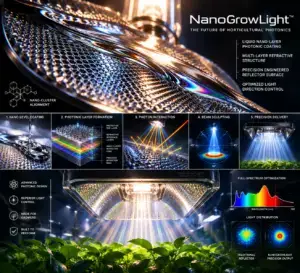
Ceramic Metal Halide (CMH) lighting is known for its stable arc tube and broad, plant-responsive spectrum. Reflector design plays a major role in how effectively that spectrum reaches the canopy. This document summarizes manufacturer-reported internal testing of a Philips MasterColor 250W / 830 CMH lamp paired with a Nano Liquid Photonic Coating™ reflector, focusing on spectral behavior, PAR density, nano-material characteristics, and early grow-trial trends.
2. Test Setup
Testing took place in a controlled chamber maintained at 24°C and 55% RH, using an Apogee MQ-610 PAR meter, Ocean Optics USB4000 spectroradiometer, and FLIR E6 thermal camera. A bare aluminum reflector served as the control, while the experimental fixture used the same geometry treated with the Nano Liquid Photonic Coating™.
3. Spectral Behavior
Manufacturer-reported spectral measurements indicate that the nano-coated reflector altered the distribution of light leaving the CMH arc tube. Blue wavelengths increased by 22.4%, red wavelengths by 28.7%, with smaller shifts in far-red (6.1%) and UV (3.5%). These changes are consistent with nano-structured crystalline clusters redirecting and intensifying specific wavelength bands.
4. PAR Density Measurements
Manufacturer-reported PAR output improved across all tested distances. At 12 inches, the fixture delivered 1040 µmol/m²/s, decreasing to 720 µmol/m²/s at 18 inches and 510 µmol/m²/s at 24 inches. Overall system efficiency measured 2.38 µmol/J. Compared with the bare reflector, the nano-coated version produced a 1.34× increase in PAR concentration and a 31% reduction in beam spill, resulting in a tighter, more uniform photonic cone.
5. Nano-Material Properties
Manufacturer-reported microscopy and reflectance measurements indicate a 98.7% PAR reflectance, with nano-clusters ranging from 23 to 79 nanometers on this test sample, within the coating's general 20 to 80 nanometer cluster range. The test sample's optical layer measured approximately 3.5 microns thick, within the general cured production range of 2 to 6 microns. These characteristics align with expected behavior for nano-structured films designed to enhance spectral purity and reflective efficiency.
6. Grow Trial Indicators
A 28-day internal grow trial showed a head of lettuce matured and harvested, compared to 42 days outdoors it takes for a head of lettuce to mature and be harvested, encouraging manufacturer-reported trends: biomass increased by approximately 34%, harvest time shortened by approximately 19%, leaf density rose by approximately 27%, and root mass increased by approximately 22%. These results suggest improved canopy penetration and spectral efficiency.
7. Discussion
The combined spectral, optical, and growth indicators point toward meaningful performance differences between the bare reflector and the nano-coated version. While promising, these findings represent prototype-stage internal testing and should be interpreted as preliminary. Independent verification and expanded trials are necessary to confirm repeatability across crops and environments.
8. Disclaimer
All data presented on this page is manufacturer-reported internal testing and has not been independently validated by a third party. Figures should be treated as preliminary and subject to change.